
Ron Berger’s famous ‘Austin’s Butterfly’ is a great lesson about how redrafting and feedback can help a child create a more accurate ‘scientific’ drawing of a butterfly. In the context of the task picture six is clearly the ‘best’ depiction of the butterfly.
If one removes the context and no longer looks for accuracy and, instead, tries to judge the drawing on its own merits – art for its own sake, which drawings are the ‘best’? I would argue that, artistically, one and four are the ‘best’.
How about these three Turner’s, which is ‘the best’?


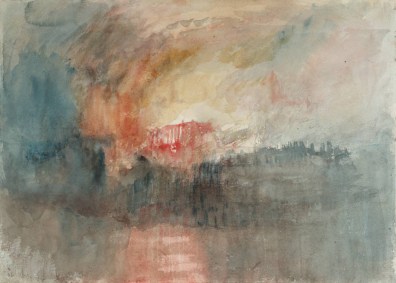
In terms of ‘accuracy’ maybe the first one, but the third, of a fire at the Tower of London, in 1841, a watercolour ‘sketch’, has an immediacy of response that might represent a different sort of ‘accuracy’, that of the artist responding to a moment in time in a way that captures something of the event beyond an accurate depiction of it. In fact, for many years, this was thought to be a painting of the fire in 1834 at the Houses of Parliament, does this mean the picture is not as good as it should be? Well, it was only a sketch but it did help Turner in developing his Art. This, from 1844, is a finished work:

The art teacher has to rely on knowledge and intuition to decide what is ‘best’, sometimes this is not so easy, especially in a lesson where Austin has already drawn the best butterfly in the first five minutes.
Paul McCartney ‘dreamt’ Yesterday, and remembered it the next morning, quickly working out the right chords, but always thinking in the back of his mind that somebody else must have written it and he remembered it because it came to him so easily. Had a teacher overworked the tune with my ‘imaginary Paul as a music pupil’ who had come up with that tune – saying it needs redrafting, it might have ruined the tune. A lesson which has a given amount of time is often too short for work to be completed. Sometimes it is too long. What to do with those minutes if a child has already created a great piece?
Well, Paul, had to work on the lyrics, ‘scrambled eggs’ was not as good as ‘yesterday’…
But arts teachers need to think what happens if a pupil comes up with perfection straight away? I mustn’t ruin it and I need to feed their aesthetic judgement and taste to ‘know’ when good is good. How do we teach a child to ‘know’ when something is good…
And not, merely, accurate?


 Trivium 21c ltd.
Leave a reply to Adam Cancel reply